Showing posts with label flooding. Show all posts

Thursday, June 27, 2013

Katrina and the Cajun Navy (7 yrs later) - Pt. 8


This is the ninth installment on this topic.
To read from the beginning please go to entries beginning 9/20/12.

1010 Lake Forest Blvd
(7 years post-Katrina)

Returning from the stairwell filled with mostly elderly folks, I pushed through the chest-deep water back to the closest boat, now positioned in the corner of the meeting room at the base of the stairwell.  Though only a few feet from the base of the steps, no-one could access the boat without submitting themselves and their senses to the chill of the murky waters or by being carried.  As my thought process moved from the initial encounter with the residents, into planning logistics, my eye caught movement from a room to the left, adjacent to the meeting area in which we were now "staging" removal of the patient souls in the stairway.

To my surprise, I saw what clearly appeared to be a young family. Dad in chest deep water, maybe in his early 30's, mom a few inches shorter, each carrying a small child aged maybe 6 and 8.  They plowed through the water as a unit moving toward the meeting room, and from their expression, decidedly toward the first boat.  My first reaction, considering those in line positioned in the stairwell to wait their turns, was that these youngsters were not following  the certain protocol I had already formulated in my mind.  They were not lending proper respect to the old folks organized in proper fashion as if they had each drawn numbers to be serviced in order and with appropriate decorum.  This young family was "cutting".  In this makeshift rescue by untrained organizers, for a moment, it kinda pissed me off.
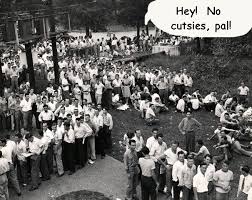


In the wisdom of the moment it struck me that, this young family was as anxious to remove itself from this indefinite aquatic isolation as were those in the stairway.  It did not appear that either group was aware of the others.  Even if they had been, my experiences later in the day would fortify the notion that among those ready to leave, "first come first served" would, in many cases be the primary protocol.  For efficiency, the young family was placed into the first boat and pushed away toward the exit allowing the next small craft to drift into place.


With the first four rescued and a few more aluminum craft drifting in to begin moving those in line, Sara ascended the first of many stairways in the building to begin her floor-by-floor “evaluation”.  Within minutes, many of the residents knew Sara's name and she knew theirs.  Instant friends.  Once the situation was assessed, I left the transport to others and joined Sara inside the building.  With my hiking boots filled with water, and my clothes saturated and dripping, I accompanied Sara up into this unexplored territory to learn the specifics of what we would be facing.

She had determined that there were no less than 10 residents at least partially confined to wheelchairs, and half as many recent surgery patients still on the mend.  Many of those who were ambulatory were weak or impaired with bad knees, legs, backs and the like, although there were a few younger families with preschool children.  We discovered that the living situations for each resident were uncomfortable but not yet intolerable.  The building housed its occupants in comfortable though not extravagant apartments.  Without running water or electricity for nearly three days, refrigerators could have held remnants of bottled water on hand before the storm.  Freezers sparingly opened and food cabinets could still hold essentials for their owners' sustenance.



We heard of a group of headstrong male residents who had moved to the roof and were bonded in the brotherhood of a permanent encampment.  As the stories went, they were staying, come hell or .... well they were staying.  We did not immediately investigate stories of them lighting campfires and refusing to leave as there was adequate need within the confines of the enclosed floors.  There were 10 or so others who declared their decision to stay, but all others were ready to do what was needed to get into a boat.  They needed no knowledge of their destination.


Occasionally, during the constant flow of boats from this location and many others in the area, I would periodically return to the "landing" to monitor the situation and coordinate, if necessary with the retrieval of residents.  "In America" anyone would expect resources and personnel to be available with coordination of efforts to transform the chaos of a natural disaster into an organized and fluid recovery.  Not yet!  As the day progressed, it became painfully obvious that the “seamless” coordination of rescue and relief operations promised by FEMA had not yet materialized.


Those brought to the road by boat were dropped in the blazing sun, on the smoldering asphalt shoulder of the highway to wait for land transport.  Their wait was excruciatingly long, but they had no choice but to remain patient, as they had nowhere else to go.  All they could do was sit, without water, without food, without their animal companions and without shelter.


Transport vehicles appeared to wander into the area without schedule or plan.  Rather than "first come first served" it became more "survival of the fittest" as many of the weaker and less agile would be brushed aside by those who best positioned themselves to enter whatever kind of wheeled transport might arrive.  Those unable to gain entry on one wagon,would wait for the next carrier to unpredictably come by.  Again, I was aggravated that this did not fit the mold of my upbringing.  However, we were forced to accept that this discourteous unfairness was just another layer of skin on this big onion that we were not equipped to deal with.
Officers and some kind citizens attempted to care for the frail and injured, and to provide priority access for those not strong enough to fend for themselves. All in all it was a situation under limited control with little organization. 

As the day wore on with the prolonged intense heat and crowds on the roadside growing, it began to eat at some of us that many folks were not feeling “rescued”.  Their placement on the highway to bake in the sun for hours, to await transport, occasionally by bus, but also by U-haul truck, open troop carrier or dump truck, was not what we envisioned or what they deserved after the ordeal they had already been through.  We had no knowledge or control over their destinations.  Our job was to get them out of the water.  We had no information, authority or input beyond that.

The high-rise residents who were able, filed out of their 168 apartments.  They ventured one-by-one, down the dark stairwells to the dock-less boat mooring.  When their turns came, they would submit to partial submersion in the increasingly acrid waters before entering one of the tin can units of the rescue flotilla.  For the entire day, our clothes saturated and skin wrinkled, we stood chest deep in water assisting each passenger. 

Those who did not need to be lifted into the boat were directed to step onto the underwater chair positioned next to it.  This provided us with assistance in getting each of them above the 4-foot water level and the additional foot and a half over the edge of the boat.  Mickey Monceaux, an 11-year charter employee of R&R, assisting those who could not do so themselves, lifted more that a couple of tons of passengers into boats during the course of the day.

Between boatloads, we would clomp up and down the stairwells, boots weighted with water, sweeping the building for those remaining.  In the later hours, those remaining presented the most challenges.  This was not due to their demeanor, as they were cooperative, kind and appreciative.  These has limitations that prevented them from crowding into the stairwells to await their turns in line for debarkation.  Despite impediments, the ones who couldn't make it to the submerged dining area to the bouncing watercraft, were nevertheless ready to go.  They expected to leave like everyone else, and they expected to do it today  Unfortunately, the circumstances evolved to the point that some would have to wait through the night... and  perhaps beyond that.


A late afternoon survey revealed four residents in wheelchairs who could not walk down the stairs, even with assistance.  One of those, a charming and pleasant lady named Connie, much younger than most of the other residents, had a serious brittle bone disease.  She was encouraging, but made it amply clear that we would risk seriously injuring her if she had to leave her electric wheelchair.  It occurred to me that housing wheelchair bound residents in a high-rise with no generator backup for elevators showed little forethought or no concern.


We considered trying to carry her from her chair down the many flights of stairs, but in our fatigued and saturated state, we risked injury to her and to ourselves trying to negotiate down the wet, slippery stairs.  We considered moving her down the 6 or 8 flights in her wheelchair, but I had discovered earlier that day how bulky, unwieldy and extremely heavy these electric wheelchairs are.  It had taken four of us to move each of three other electric wheelchairs without occupants earlier in the day.  Connie was scared to go and she was scared to stay.  Although the sun was still shining, we had no options.

In one of the hallways, on a mid-level floor, lay a gentleman in his 60's or older, on his back, either sleeping or unconscious.  I learned later that he had unfailingly assisted Sara throughout the day in locating and organizing residents. Now at 5:00 p.m., he was passed out in a hallway.  “Diabetic coma” we were told by a gentleman who we guessed was a relative or a close friend.

In an apartment, we found two residents recovering from recent surgeries.  With their spouses, they were packed and waiting in anticipation at the doors of their apartments as if expecting a taxi to arrive to drive them to the airport.


The boat returned with the news that there was no insulin for our diabetic friend, no other medical resources and no further land transport that afternoon.


Those remaining had physical impairments of some kind, limiting their mobility at very least. Earlier, I had asked each of them if they wished to risk injury by being moved with our limited resources, and each had said yes.  As the daylight was waning I returned to inform each of them that we could not take them that day.

I could only relate this information to our unconscious diabetic friend through his nephew who would stay to tend to him through the night without medication.  We lifted that gentleman off the floor and into his wheelchair and I mustered some weak words of encouragement for his nephew.  I felt helpless and guilty that I was leaving them for the night.  The only consolation was that they were better off here in familiar shelter than left on the roadside to fen for themselves.


We plodded wearily down from the upper floors, one fight at a time, checking each level for residents.  Almost desperately, one of the long-married couples called to me as I walked away.  Seated in their living room, dressed and prepared to leave, they let me know they would be ready at daybreak.  I nodded and assured them that they would not be forgotten.

Connie, the lady with the brittle bone disease and confined to her wheelchair, sat at her spot by the window and looked toward the city's skyline over the flood waters.  As everyone seemed to be doing mentally, she struggled openly to comprehend it when I told her the entire city looked like the view out of her window.  I emphasized that no one knew when it was going away.  On her shoulder sat a parakeet she referred to as “her life”.


Although Connie was usually surrounded in this building by hundreds of other residents, she was essentially confined to her chair and to this space due to her condition.  This bird represented something akin to family to her.  Now, it was only her and her parakeet, being left to stare out the window at the sky, the moon and the water while contemplating what life held for her next.  She beseeched me to promise that I would return in the morning.


Many of these occupants were at times in their lives that they had little more than themselves and the possessions contained in the confines of their living quarters.  Their lobby, meeting room and cafeteria had by this time been under water for three days and would be for an indeterminate time to come.  The parking lot, before Katrina, was the convenient welcoming area for the vehicles of family and friends who might visit, and for medical or emergency vehicles when needed.  Now it too was cut off by the same darkening liquid that would seem to grow darker and thicker during the night.

Spirits buoyed by the arrival of boats this morning were now being replaced by tentative patience.  These old souls, now stranded for three days feared that no-one would ever return if the opportunity today was missed.

Encouraged by information that Ronny had befriended a group of volunteers with fire-rescue and EMT experience as well as equipment, I assured the residents that they could expect a level of safety in their removal tomorrow that we could not have provided them today.

Moving into the sunlight out of the bowels of the last dark stairway, I thought for a moment that we had could make one or two more loads.  Just as fleetingly, my  mind flashed to images of the wet stairs, the heavy wheelchairs, the impaired residents and the turmoil at the roadside throughout the day.  I accepted that we had done all that we could that day, and that those left in their familiar surroundings above would be in the best place until reinforcements arrived in the morning.  Maybe by then, the area-wide strategic operation might be organized enough to actually do something with these less fortunate ones who needed care for their impairments.

My 50-year old body, pushed to its limits, did not feel pain or fatigue, presumably thanks to my adrenaline-diluted blood.  Little in my usually mundane daily schedule could compare with my experiences of the last day and a half.  It seemed like weeks since this had started.  The isolation and poor conditions were unlike anything I had encountered before.  The amount of physical effort and mental stress had been at levels ten or a hundred fold what I normally dealt with.  At the same time, this experience was awakening senses long unused and was in many ways invigorating. 


We floated slowly and carefully, retracing our flooded path back to the roadside dock.  The waters and the day itself seemed refreshingly serene as the late afternoon sky turned orange and reflected off of the waters around us.  Though it seemed like the end of the day was approaching, I knew nothing of the adventures we would face in its remaining few hours.


To be continued


Friday, October 26, 2012

Katrina and the Cajun Navy - 7 Years Later (Pt. 4)


This is the fifth installment on this topic.
To read from the beginning please go to posts beginning 9/20/12.


Before, during and since the Big Girl had passed through, our consumption of news programming from all types of media outlets had been virtually uninterrupted.  From the time we began to organize and mobilize on Tuesday morning, our information had come exclusively from radio.  In the now well-established age of 24-hour news coupled with the developing genre of reality television, aggressive media seemed intent on dramatizing the already dramatic.  Achieving increased market share was the primary goal to be achieved by many so-called "news organizations".  Once informative, fact-based news reporting was being replaced in this generation by often inflammatory and polarizing cable networks boldly promoting political, social and religious agendas as purported "news".


CNN Breaking NewsAdd to the mix the exploding social media of the internet, the reporting of events took on the characteristics of armies on the battlefield fighting to the death for small pieces of ground.  If in the past, people consuming media wanted to be occasionally titillated by risque double entendre, they had now been transformed  into voracious gluttons for a diet of over-the-top shock.


What chills the conscience on Tuesday becomes the norm by Wednesday, and has to be met and exceeded by Thursday.  With these underpinnings, national media had to transform the information in the developing drama post-Katrina and entertain the citizens of the world on their unlimited supply of electronic devices


Inside of the levees though, the source of the news had been thrown back into the relative Dark Ages.  Limited communication made the translation of piecemeal information into a story unreliable.  In many cases reporting of events was over- dramatized guesswork.  Across the country and the world, those outside of the levees teetered on the edges of their seats as events unfolded.

It could be said that there had previously been a relatively standard pattern to the development of most disasters.  The storm, or other event, would approach, strike and create a peak of destruction and then subside.  During the final phase, rescue and re-building resources could enter the affected areas and render aid. 


Floods in Bangkok. Photo: EPA


Unlike the flooding in the case of many natural disasters that soon subsided after the onslaught of the rising waters, this situation was deteriorating tragically and disproportionately with the passing hours.  The water rose, and then it stayed.


Horribly, we would find out later, its victims in those first hours and days, were unsuspecting elderly and/or handicapped.  Surely, to their horror, they awoke trapped by rising flood waters, many in their own beds, in their own homes.  Nowhere to go.


Unable to flee or protect themselves.  Many who could flee the rising water, found their way into their attics, only to be eventually confronted there with stagnating air that would heat to desert-like temperatures as the sun rose and passed across the south Louisiana sky.  No relief was provided by the humid, Mississippi Delta nights that cooled only into the 80's before quickly transitioning in the daylight hours into virtual outdoor saunas.

Add to all of this, the fact that assistance was not flowing freely into the city.  Passionate people felt compelled to do something to assist, and help was mobilizing all over the country, and the world.    However, getting into the flooded bowl of the city was proving to be more difficult than our entrance in the early hours of the crisis.  As the hours passed, the bureaucracy grew.


We were happy to be inside, and to be in
a position to do something positive.  I think we all sub-consciously expected to enter this American city and promptly have access to resources.  You know, "We can put a man on the moon, but..."  Surprisingly, no...stunningly, we were carrying what came to be, relatively speaking, enviable resources.  What we had was minimal, but in what appeared to be a devastated infrastructure, we would  hold on tight to the tools we had.


Communication was a different story.  OK.  No it wasn't.  Land telephone lines were down, and like the electricity, old-fashioned phone communication was probably out for days, if not weeks.


But in this wireless era we would be OK with our cell phones.


OK, no we wouldn't.  In the age of ever-expanding digital communication we believed that contact with the world was always at our fingertips.  Wrong again!  Apparently, a few downed or damaged cellular towers could disable communication as easily as downing a few old-fashioned radio towers or telephone poles could.


Limited texting would become available in a day or so, but for providing communication either inside or outside of the levees, cell phones were about as useful as two paper cups on a string.  Whodathunkit???


Police, fire, rescue, emergency personnel and volunteers could communicate with each other on only a single frequency.  Throughout the entire metropolitan area of the city, one frequency was being used in a make-shift party-line mode.  Everyone could talk, and deciphering the identity and location of the participants was as challenging as the message itself.  Nothing seemed to be coordinated, and people were in desperate need in conditions that appeared insurmountable.


Initially, we were just hopeful that we might be able to be helpful.  As the hours passed, we experienced a growing sense that we were absolutely essential to a sorely deficient rescue effort and that we might even save a few lives.  That sense of urgency and potential usefulness in such an indescribably huge event filtered, and maybe blocked out completely any apprehension, fear or hesitation.  In a situation in which good judgment would have otherwise produced concern, caution, planning and possibly retreat, we continued blindly on our unwavering course into the unknown.  The familiar surrounding of this great city that we loved provided comfort and hope keeping safer, conservative judgment at bay.


Our determination and the need to adapt to our surroundings and circumstances left no time or opportunity for worry.  We would later discover that our families , out of contact and feeding on the media hyperbole were beyond anxious.  Many, we would learn were downright scared for us, fearing the worst.  I'm sure that some were angry at us for our foolishness...at our ages.  With no direct contact they found it easy to work themselves up into a frenzied combination of fear and anxiety.  Fortunately for us, they could not confront us about it until later, after they knew we were safe.

Focused on the purpose of our mission, on the edge of the great Mississippi River and in the heart of the now devastated city, we were still waiting.  With our boats still trailered and not in the water, our frustration was compounded by delays.  Adrenaline staved off fatigue from the day already full of activity and high drama.  The boats were not afloat.   Our constant thought was, “There are people in attics, on rooftops and in need.  Let’s go!”, while "Hurry up and wait" seemed to be the resonant, underlying theme.  

Finally our long line of trucks and boats weaved around the Casino building at the foot of historic Canal Street like a Chinese parade dragon.


We came to a halt facing down-river toward the convention center and the river bridge, into the direction from which we had come.  We had made almost a full circle around the huge casino and found ourselves at the front of the pack.  While waiting in line, we had gathered some sketchy details about the situation in the rest of the city.


From the foot of Canal Street we could see the flood waters only a couple of blocks away.  It was high and dry from the river levee almost to Bourbon Street where ankle deep water began a northward progression to a full 12' depth a few miles away at the Pontchartrain lakefront.


The only 
area that the broken levees and the lake's waters had left accessible by land was a strip along the crescent of the Mississippi River, as narrow as only a few blocks in some areas.  It seemed odd that the area closest to the river would spared the wrath of the flood, but centuries of pre-levee flooding and silting had created this high ground upon which this city was born.  

We would learn that the buildings, vehicles and virtually all of the assets of the New Orleans Police Department were under water.  All of the assets except the human ones.  At the front of the line we now occupied, we encountered two gentlemen in street attire.  


They presented as authority figures and acted as if they were overseeing a plan of action directed at our goal.  Lt. Dean and Capt. Bayard of the New Orleans Police Department appeared fatigued, but they were aggressively organizing and directing boat owners, and assigning groups for deployment.  Surprisingly, I recognized Timmy Bayard as a fellow alum of Brother Martin High School and a guy with whom I used to occasionally play pick up basketball 30+ years ago.  Their enthusiasm and devotion to what they were doing was evident as they busily attempted to transform a hodge-podge rescue operation into a well-oiled machine.


It was determined that we would deploy to that part of the Ninth Ward of Orleans Parish separated from the Lower Ninth Ward by the Industrial Canal.  The Inner Harbor Navigation Canal (its proper name) is a man-made canal, with locks,  connecting Lake Pontchartrain to the Mississippi River.  As its nickname implies, it is used for docking, repairs and heavy industrial activities related to shipping.  Three major levee breaches had occurred on the eastern side of the canal opening the way for  indistinguishable lake and river waters to flow mercilessly into  the largely-residential Lower Ninth Ward.  By this time it was entirely inundated.


The Upper Ninth Ward received most of its flood waters from levee breaks nearer the lake in the 17th Street and London Avenue Canals.  These flooded areas were accessible by vehicles only from dry ground in the area of the river.  Because of the location of downtown and the French Quarter on the uphill side of the Mississippi's crescent where the river flows north, we would need to drive north, parallel to the river to approach our destination.  

The drive would be less than 3 miles.  Under normal conditions, absent debris and downed trees and power lines, it would take less than 10 minutes.  The planned launch site was near enough to the levee breaks that we were cautioned not to motor our boats within two blocks of them.  Officers' Bayard and Dean provided instructions referencing Poland Avenue, the Lower Ninth Ward, the St. Claude Avenue Bridge and similar local landmarks.


Though these were familiar to me, my southwest Cajun podnas were like deer in the headlights.  They assumed, without knowing, that I had some idea of where we would be going.  Though they were all hardened blue collar country boys, they all were dealing with their own personal trepidations in this strange place. Most of them could find their way out of the Southwest Louisiana marshes in the dark, while dragging a boatload of freshly-killed game, but they were completely unfamiliar with the city’s confusing web of tangled streets.


Laid out over hundreds of years, as dry ground was re-claimed from swamps, the city's streets are confusing to motorists with maps, and more so to southwest Louisiana boaters without them.  Our hopes were to have an escort to our destination and guides at our sides beyond that to keep order and to conduct an effective and efficient rescue operation.

My concerns heightened when I witnessed Lt. Dean re-explain his instructions three times to our blue-jean clad NOPD escort officer.  It was some consolation that our group would be able to remain together.  If our guide got lost we would all be lost together.  In any event, there was devastation throughout the city and if we didn't wind up where we were supposed to be, there surely would be ample work to keep us busy.   With no hesitation, and with blind trust, our parade dragon fell in behind our unsure escort.  We eased slowly around the casino again, across Canal Street and into the famous French Quarter.


Decatur Street

Decatur Street is the street closest to the river running parallel to it through the Vieux CarrĂ©, or the “Old Square” as it was named by the original French settlers who laid out the city in a grid on this limited area of high ground.  The area, approximately 13 blocks along the riverfront and 6-8 blocks deep had come to be known worldwide as the French Quarter.  To locals it is simply “The Quarter”.  When New Orleans was settled in the early 1700’s, the Quarter was high ground surrounded by lowlands and swamps.  Those lower areas would be claimed over the years for farming, then for residential and commercial development as this world-class trade center grew. 


Ferdinand DeSoto of Spain "discovered" the mighty river in 1542, though it had been known and used by Native Americans for thousands of years.  Though the   Spanish claimed it, they found the area too wild and made no attempt to settle it.  In 1682 LaSalle claimed it for France and named it “Louisiane” for France’s King Louis XIV who was looking to expand his empire.  On Mardi Gras day in 1699 Iberville reached the mouth of the Mississippi River from the Gulf of Mexico.  However, the entrance to the river was so treacherous that he established a permanent settlement on the gulf coast, rather than risk losing his ships trying to enter the river's mouth.

In 1718 Iberville’s brother, Bienville created a permanent settlement in a crescent shaped section of the river and named it in honor of the Duc d’Orleans.  The site chosen was a small area of high ground that had long been used by local Indians as a depot and market for goods.  The location was ideal as it was a short distance between the river and the large shallow lake to the north named by the French settlers for the Duke of Pontchartrain.  Nearly three centuries later, Katrina (with the help of failed levees) had in short course turned these historically friendly water bodies into weapons of destruction during her swift pass through the city.


Decatur Street was high and dry as was most of the French Quarter.  The amount of clutter and fallen trees increased as we approached Cafe' du Monde and Jackson Square, both of which, except for the storm, would have been packed with tourists and locals seeking the pleasure of some beignets and take in the views of the old military square.


Just past the square and just before the historic French Market, a large ornamental tree blocked 2/3rds of the roadway.  Slowing and creeping to the side, against the high concrete curb,  we squeezed our train past it, to be greeted by the twisted and tattered cloth awnings of the old market.


Past the old open air market and at the outer boundary of the Quarter rests the beautiful old U.S. Mint building.  Just before it, sat what appeared to be a huge, bronze aluminum foil ball, the size of a dump truck.  On a closer look, it appeared that the entire copper roof of the historic building had been stripped off, rolled into a ball and placed curbside for pickup.


Across Esplanade Avenue, passing through the Fauborg-Marigny District, the travel became more treacherous with more downed lines, trees and debris.  Our forward travel was blocked at the T-intersection of Royal Street with Poland Avenue by the imposing F. Edward Hebert Naval Compound, named for the only person I can recall who served the area in the U.S. Congress while I was growing up.


We turned to the left, away from the river, heading up Poland Avenue.   Like many other streets in town it is divided by a neutral ground (median) on which grow stately old live oaks.  A few blocks up, we approached a location manned by four or five Wildlife & Fisheries agents.  A block or more beyond their location, an accumulation of 50-100 locals could be seen at the edge of the flood waters.

Wildlife Agent Eddie Skinner had the unfortunate responsibility of throwing cold water on our mission. 


“I don’t know who sent you, but we’re shutting down this location.  We can’t send y’all out there without supervision or security.”

Ultimately, after towing the department line of bureaucratic talk speaking generally to safety and security, he reluctantly got to the point.  He described the situation as being one fueled by some of the locals escaping the flood waters with their salvaged possessions consisting more of “their liquor instead of their clothes”.    It had been a long day and these folks were apparently, young enough, healthy enough and close enough to waters edge to wade out with some essentials.  Agent Skinner as the official representative of the Department of Wildlife & Fisheries , and hence the great State of Louisiana, had been determined that a definite security risk was presented.  We could not blame him, despite our desire to get started.


Clearly it had been a long day for the agents and the residents whose lives had been upended by the storm and the aftermath of the broken levees.  The agent, with little sleep since passage of the storm, were not in a position to competently provide security or supervise continued rescue efforts into the evening.  He politely, but firmly put the quietus on our enthusiasm, wisely noting that our intentions would be of little value if our operations could not be carried out safely.  Having heard stories from older generations of the historically rough nature of the Lower Ninth Ward well back into the 19th century, my argument with Agent Skinner ended.  Our parade dragon weaved its way through the high, dry streets nestled against the riverfront, retracing its path back to our starting point at the foot of Canal Street.

Lt. Dean, still at work, offered to direct us to another area to begin our work during the evening, but good sense prevailed.  Some of the group who had previously conducted nighttime search operations in areas with which they were familiar, encouraged us to start out fresh at daybreak rather than encounter the risks of an evening search in an unfamiliar area distorted by streets that had been transformed into canals.  Having no home base, we were directed by officers to park on the street car (trolley) tracks in the median of Canal Street.

These tracks had recently been built on this “neutral ground”, as it is known by Orleanians, to be used by new, modern trolleys to cover expanded routes in the city.  It was a bold and aggressive attempt by the city administration to use the world-renowned allure of the St. Charles Avenue streetcars to capture a larger share of the tourism market while providing expanded mass transit for the city.  The tracks, now vacant, would be our home for the night.


Home Sweet Home


Our enthusiasm temporarily bridled, we were still animated after parking our vehicles in the heart of one of the most historic cities in the world.  At least within a 3 or 4 block area, we could establish some semblance of normalcy.  The towering hotels and office buildings, usually brightly lit and teeming with activity throughout the night, were dark against the starlit night sky.  The only light came from the covered overhang of the casino and an area a few blocks up Canal Street, at the water’s edge, near Bourbon Street.


Under the Harrah’s Casino overhang that usually protected busloads of visitors willing to drop cash into the coffers of the state and Harrah's in hopes of taking home a jackpot, was located the new headquarters of law enforcement operations of the New Orleans Police Department.  With most of their station houses and vehicles underwater, this would be the NOPD command center for the next week or more.


Up Canal Street, a giant, blinking warning arrow could be seen, placed there to direct, away from the new canals of the city, whatever vehicles that might wander there.  Our adventure took on the air of a camp out among close friends filled with stories and laughter.  With trucks and boats resting under the clear starlit sky, in the balmy humidity of the Big Easy, we tried to claim our spots on the concrete and talk about the day, the beginning of which seemed like weeks ago.  There was no trepidation or concern with what might lie ahead of us.

The wheel of one of the boat trailers had lost a bearing.  Mechanical as I am (or am not) my only clue that this was really not a good thing was the sight of the boat, on its trailer, in the right lane of the six lane street.  Against the backdrop of the huge casino building, it was disconnected from its land transportation and appeared to be abandoned without an owner.  Without new bearings, the trailer would become a part of the abandoned property dotting the landscape.

Four members of our group decided that a one and a half hour drive back up Interstate 10 to Baton Rouge was the only hope to get the parts to make the needed repairs.  There were no stores functioning in the metropolitan New Orleans area, and looting an auto parts store did not seem to be an acceptable option.  We knew that security at the edges of the City was tight, and were fearful that anyone leaving the confines of the disaster would not be allowed to return.  As they left, we had no idea if we'd see them again before returning home. 


Those of us who remained behind shared the chips, crackers, cookies and Gatorade we had.  Speculating on what the morning would hold and whether the four who ventured out would return, each of us began to trail off to try to find a place to perch for the evening to try to get some rest.  We chose our spots on the curbs, in the beds of pickup trucks, on boat decks or in truck cabs, to rest or to try to sleep.


By 1:00 a.m., the bearing hunters had returned with extra bearings and Waffle House sandwiches to supplement our snacks.  They had come upon an open restaurant south of Baton Rouge and had claimed the last of its food supply that had been depleted by the mass of evacuees.  They proudly described their negotiation of a $70 discount off of the $240 bill after detailing the nature of our mission.  This was the first of an endless series of unsolicited acts of generosity and kindness we would witness over the course of the next few days.


TO BE CONTINUED